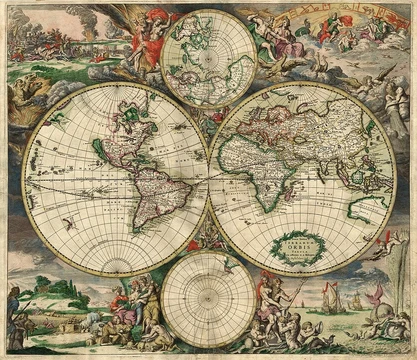
West
One of the four cardinal directions, opposite east.
West is a cardinal direction, one of the four main points on a compass. It lies directly opposite east and marks the point on the horizon where the Sun goes down each day.
The term "west" comes from a Germanic root that spread into several Romance languages—for example, *ouest* in French, *oeste* in Spanish and Portuguese, *ovest* in Italian, and *vest* in Romanian. This word traces back to the Indo-European root *wes, a shortened form of *wes-pero, meaning "evening" or "night." It is related to the Ancient Greek *hesperos* (evening, evening star, western) and Latin *vesper* (evening, west). Other languages follow the same logic: Latin *occidens* comes from *occidō* (to go down, to set), and Hebrew *maarav* derives from *erev* (evening). West is often shortened to the letter W.
For navigation, setting a compass bearing of 270° points west (assuming magnetic north matches true north). West is the direction opposite Earth’s rotation, so the Sun appears to move steadily westward until it sets. This is not the case on Venus, which rotates backward; there, the Sun would rise in the west and set in the east, though the planet’s thick clouds block any view. On a standard map with north at the top, west is on the left. Traveling continuously west follows a line of latitude.
In weather, Earth’s rotation causes prevailing winds in the middle latitudes (roughly 35 to 65 degrees) to blow from the west—these are called the westerlies.
Culturally, "the West" often refers to the Western world: the European Union, EFTA countries, the United Kingdom, the Americas, Israel, Australia, New Zealand, and partly South Africa. This concept traces back to the Western Roman Empire and Western Christianity. During the Cold War, "the West" typically meant the NATO alliance, as opposed to the Warsaw Pact and non-aligned nations. The term continues to be used, though its meaning has become less clear.
Symbolically, in Chinese Buddhism, the west represents movement toward the Buddha or enlightenment, as in the classic tale *Journey to the West*. The ancient Aztecs saw the west as the realm of the great goddess of water, mist, and maize. In Ancient Egypt, the west was the gateway to the underworld, linked with death but not always negatively; the goddess Amunet personified this direction. The Celts believed that beyond the western sea, off the edges of known maps, lay the Otherworld or afterlife. In Judaism, the west is associated with the Shekinah (God’s presence), because the Tabernacle and later the Jerusalem Temple faced east, with the Holy of Holies to the west. According to the Bible, the Israelites crossed the Jordan River westward into the Promised Land. In Islam, cardinal directions are not given fixed symbolic meanings; instead, the Qur’an states (2:115): "To God belong the East and the West. Wheresoever you turn, there is the Face of God." This emphasizes that spiritual truth is not bound to any direction. In American literature, such as *The Great Gatsby*, moving west can symbolize gaining freedom, echoing the settlement of the Wild West and ideas like the American frontier and Manifest Destiny.
- Type
- Cardinal direction
- Abbreviation
- W
- Opposite direction
- East
- Etymology root
- Indo-European *wes (evening, night)
- Cultural associations
- Western world, freedom, afterlife
Lore & Background
West is one of the four cardinal directions, opposite east, and is defined as the direction in which the Sun sets on Earth. The word derives from the Indo-European root *wes, related to the concept of evening and night, and is cognate with the Latin *vesper* and Ancient Greek *hesperos*, both meaning "evening" or "west." In Latin, the term *occidens* also means "west," from the verb meaning "to go down" or "to set," and Hebrew *maarav* similarly stems from the word for "evening." West is abbreviated as W. On a compass, west corresponds to a bearing of 270°, and on a standard map with north at the top, west is on the left. Moving continuously west follows a circle of latitude. Due to Earth's rotation, the prevailing winds in middle latitudes (between 35 and 65 degrees) often blow from the west, known as the westerlies. Culturally, "the West" refers to the Western world, including the European Union, the United Kingdom, the Americas, Israel, Australia, New Zealand, and parts of South Africa, with roots in the Western Roman Empire and Western Christianity. Symbolically, in Chinese Buddhism, west represents movement toward enlightenment; the Aztecs associated it with a goddess of water and maize; and in Ancient Egypt, it was the portal to the netherworld, personified by the goddess Amunet. The Celts placed the afterlife beyond the western sea. In Judaism, west is toward the divine presence, as the Temple faced east with the Holy of Holies to the west. In Islam, the Qur'an states that east and west belong to God, emphasizing divine omnipresence over directional symbolism. In American literature, moving west has symbolized freedom, linked to the settling of the Wild West.
Reader's Guide
West holds significant cultural and symbolic meanings across civilizations. In Chinese Buddhism, it represents movement toward enlightenment. The ancient Aztecs associated it with the goddess of water, mist, and maize. In Ancient Egypt, west was the portal to the netherworld, personified by the goddess Amunet. The Celts believed the Otherworld lay beyond the western sea. In Judaism, west is toward the Shekinah of God, as the Temple faced east with the Holy of Holies to the west. In Islam, the Qur'an states that east and west belong to God, emphasizing divine omnipresence. In American literature, moving west has symbolized gaining freedom, linked to the settling of the Wild West. The phrase 'the West' also refers to the Western world, including the European Union, the United Kingdom, the Americas, Israel, Australia, New Zealand, and partly South Africa, with roots in the Western Roman Empire and Western Christianity.
Did You Know?
- West is the direction opposite that of the Earth's rotation on its axis.
- On Venus, the Sun would rise in the west and set in the east due to retrograde rotation.
- The word 'west' derives from the Indo-European root *wes, meaning 'evening, night.'
- In Ancient Egypt, the West was considered the portal to the netherworld.
The Art and Science of Mapping
Cartography sits at the intersection of science, aesthetics, and technical skill, operating on the core assumption that the physical world—or even an imagined one—can be translated into a model that conveys spatial meaning to a viewer. At its heart, the discipline asks a cartographer to make a series of deliberate choices: what to include, how to flatten a three-dimensional surface onto a two-dimensional plane, what to strip away as irrelevant, and how to arrange the remaining elements so the final product speaks clearly to its intended audience. These tasks span map editing, projection, generalization, and design. The field also serves as a theoretical and practical backbone for modern geographic information systems and geographic information science, meaning that the principles developed over millennia continue to underpin the digital mapping technologies relied upon today.
Roots in Antiquity
The earliest attempts to chart the world stretch back millennia, though pinpointing the true first map remains contested because the term itself is loosely defined and certain artifacts might not be maps at all. A wall painting possibly depicting the Anatolian settlement of Çatalhöyük, dating to the late seventh millennium BCE, is one candidate. Geometric patterns of dotted rectangles and lines carved into alpine rock faces in France and Italy, from the fourth millennium BCE, are widely read as representations of cultivated fields. The oldest surviving world maps come from ninth-century BCE Babylonia, one placing Babylon on the Euphrates encircled by a bitter river representing the ocean, and another positioning the city north of the world's center. In China, geographical writing dates to the fifth century BCE, and the oldest extant Chinese maps originate from the State of Qin during the Warring States period.
The Medieval and Islamic Cartographic Tradition
Yet the most influential cartographic achievement of the medieval period came from the Islamic world. In 1154, the Arab geographer Muhammad al-Idrisi compiled his Tabula Rogeriana, also known as the Book of Roger, by weaving together firsthand accounts from Arab merchants and explorers covering Africa, the Indian Ocean, Europe, and the Far East with inherited knowledge from classical geographers. The result was a detailed atlas divided into seven climatic zones, each accompanied by extensive textual descriptions, alongside a world map shaped largely by Ptolemaic ideas but enriched by multiple Arab sources. Al-Idrisi also produced a smaller circular map oriented with the south at the top and Arabia at the center, and he estimated the Earth's circumference with an accuracy within ten percent. For the next three centuries, his work stood as the most precise world map available.
Redrawing the World in the Age of Discovery
The Age of Discovery, spanning the fifteenth through seventeenth centuries, transformed European mapmaking as cartographers combined centuries-old inherited charts with fresh observations from explorers and new surveying instruments. The magnetic compass, telescope, and sextant each contributed to growing accuracy. In 1492, Martin Behaim, a German cartographer advising Portugal's King John II, crafted the oldest surviving globe of the Earth. Portuguese cartographer Diogo Ribero created the first known planisphere with a graduated equator in 1527, while Italian Battista Agnese produced at least seventy-one manuscript atlases of sea charts. In the realm of projection, Johannes Werner refined an equal-area, heart-shaped cordiform projection used through the sixteenth and seventeenth centuries, from which later sinusoidal and Bonne projections evolved by shifting the standard parallel. Then in 1569, Gerardus Mercator published his now-famous projection, employing equally spaced vertical longitude lines with latitude lines that widen progressively toward the poles.
Frequently Asked Questions
What is West in the context of map projections and cartography?
West is one of the four cardinal directions used as a fundamental reference axis in cartographic systems. It sits directly opposite east and is conventionally abbreviated as W on compass roses and map legends.
Where does the word 'west' originate?
The term traces back to the Proto-Indo-European root *wes, which carried the sense of 'evening' or 'night.' This same root gave rise to Ancient Greek ἕσπερος and Latin vesper, both linking the direction to the time of day when the Sun sets.
Why is West important in cartographic foundations?
As a cardinal direction, West provides one of the two horizontal axes (along with East) that anchor coordinate grids, graticules, and orientation conventions on every map projection. Without it, the standard north-up, east-right framework for reading maps would be incomplete.
What cultural associations are tied to the direction West?
Beyond its purely geometric role, West is culturally linked to concepts such as the Western world, ideas of freedom, and in many traditions, the afterlife. These associations often appear in historical map labels, allegorical cartography, and symbolic world representations.
More in Map Projections & Cartography Foundations 1-24
Spotted an error? Know more?
This is a living reference — every entry is fact-audited, and reader corrections feed straight into our audit queue. Suggest an edit · See this site's audit record